Back to School Pre-K Sublimation: Design-Ready Assets for High-Quality Print Production
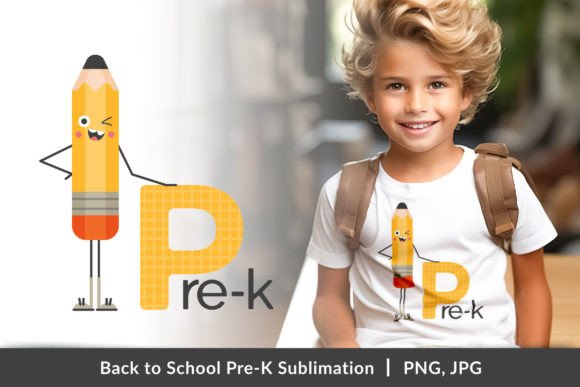
Back to School Pre-K Sublimation refers to a curated set of print-optimized design assets specifically created for early childhood education branding, classroom décor, and custom apparel—designed from the ground up for sublimation printing. These aren’t generic clipart packs or scaled-down web graphics. They’re production-grade files built with precision: one isolated PNG on transparent background for flexible layering in design software, and one high-resolution JPG (4500 × 4922 px, 300 DPI) optimized for full-bleed transfers onto polyester-blend substrates like tumblers, tote bags, youth tees, and laminated name tags. The “Pre-K” designation signals intentional age-appropriateness—soft shapes, clear outlines, developmentally supportive themes (letters, numbers, emotions, routines), and color palettes calibrated for readability and visual calm.
Where This Fits in Your Real-World Workflow
You don’t start with sublimation assets—you start with a need: a school supply drive logo refresh, a teacher appreciation bundle, or branded materials for a new preschool orientation program. Back to School Pre-K Sublimation enters your process at the asset acquisition stage—after strategy and before output. It’s not a template system or a SaaS tool; it’s a foundational resource that reduces friction between concept and physical delivery. For educators ordering class t-shirts, it eliminates hours spent tracing low-res images or adjusting proportions. For small-batch printers, it cuts prepress time by removing manual background removal, DPI upsampling, or color profile guessing. For freelance designers building client deliverables, it provides a consistent, licensed starting point—no attribution required, no usage ambiguity.
Compatibility and Integration: How It Works With What You Already Use
These files integrate cleanly into standard design and production pipelines. The PNG works natively in Adobe Photoshop, Illustrator, Affinity Designer, Canva Pro, and Cricut Design Space—its transparency allows non-destructive masking, easy recoloring via layer blending modes, and seamless compositing over textures or gradients. The high-res JPG is purpose-built for RIP (Raster Image Processing) software used by sublimation printers: its exact pixel dimensions match common transfer paper sizes (e.g., 13″ × 18″ sheets), and its 300 DPI resolution ensures crisp edge definition even when printed at 100% scale on curved surfaces like mugs. Both files embed sRGB color profiles, minimizing shifts between screen preview and final transfer—critical when matching school colors or district branding guidelines.
Practical Implementation Tips for Consistent Output
Start with purpose-driven selection—not aesthetics alone. Ask: What surface will this print on? What size range does it need to cover? Will it be viewed up close (name tags) or at distance (hallway banners)? The PNG’s transparency makes it ideal for layered applications: drop it onto a soft pastel background for a gentle bulletin board header, or place it inside a circular mask for a clean ID badge icon. The JPG excels when you need fidelity without editing—drag it directly into your printer’s queue for fast turnaround on bulk orders. Always verify your printer’s recommended bleed settings before final export; most sublimation workflows require 0.125″–0.25″ extra space around edges, which these assets accommodate without cropping essential elements.
Quality Control and Long-Term Usability
Consistency across batches depends on file integrity—not just resolution, but structural soundness. These assets avoid anti-aliased edges that blur during heat transfer, use vector-derived outlines (even in raster form), and maintain a minimum line weight of 2.5 px at full scale—ensuring legibility after sublimation’s natural slight diffusion. Unlike free downloads that compress detail or embed watermarks, this set preserves clean contrast between foreground elements and implied negative space, reducing ink bleed risk on light substrates. For long-term use, organize them using descriptive naming: back-to-school-prek-sublimation-apple-4500x4922.jpg and back-to-school-prek-sublimation-apple-transparent.png. Store both versions in the same folder—this avoids version confusion during urgent reprints or last-minute client revisions.
Efficiency Gains Across Roles
- Educators: Upload the PNG directly to your school’s Canva account, add student names using a bold, dyslexia-friendly font, and order 30 personalized folders in under 15 minutes—no graphic designer needed.
- Small Business Owners: Import the JPG into your Sawgrass Print Manager, assign correct ICC profiles for your specific blank products (e.g., “Polyester Youth Tee – Light”), and batch-print 50 units with one click—zero manual scaling or sharpening adjustments.
- Freelance Designers: Drop the transparent PNG into a multi-layered brand kit (logo + icons + patterns), then export as a single PDF with embedded crop marks—delivering press-ready files clients can hand off to any sublimation vendor.
- Hobbyists: Use the PNG in Cricut Design Space to create iron-on transfers for cotton-poly blends—its clean edges prevent weeding errors, and its size scales accurately from 2″ keychains to 12″ wall decals.
Planning Ahead: When to Acquire and How to Scale
Timing matters. Order or license Back to School Pre-K Sublimation assets 6–8 weeks before your first production deadline—not during peak August rush. That window gives you time to test prints on your actual blanks (fabrics vary in polymer coating thickness), adjust color balance if needed, and build reusable templates. If you serve multiple schools or grade levels, treat each asset as modular: combine the apple icon (PNG) with a number chart graphic (separate asset) to create a counting activity mat, or overlay the backpack outline (JPG) with editable text layers for personalized welcome kits. Scalability isn’t about quantity—it’s about interoperability. These files are designed to work together, not in isolation.
Usability Beyond Sublimation
While built for heat-transfer workflows, their technical specs unlock secondary uses. The 4500 × 4922 JPG meets print standards for large-format vinyl cutters (when converted to vector paths via auto-trace), and its resolution supports clean 8.5″ × 11″ handouts without pixelation. The transparent PNG functions equally well in digital contexts: embed it in Google Slides for interactive morning meetings, or animate it subtly in Lottie-compatible tools for parent-facing apps. This dual-purpose utility means one purchase supports both physical classroom implementation and digital engagement—reducing redundant licensing and simplifying asset management.
Making It Fit Your Routine—Without Overhauling It
You don’t need to change how you work to benefit from Back to School Pre-K Sublimation. If your current process involves sourcing images from three different sites, manually checking DPI, and rebuilding layers each time, slot these files in as direct replacements. If you use standardized print checklists (e.g., “Confirm bleed,” “Verify sRGB,” “Test on blank substrate”), add “Validate PNG transparency” and “Confirm JPG matches target sheet size” as two-line items. No new software, no training curve—just faster execution, fewer reprints, and more reliable outcomes. That’s the practical value: not novelty, but reduction of known friction points in real educational and creative production environments.